Rajasthani Thali vs Gujarati Thali: What Is the Difference?
Picture this. You sit down at a thali restaurant and small steel bowls start landing on your plate. Then comes a man with a ladle and a look that says resistance is useless. You take a spoon of dal, braced for chilli, and it tastes faintly of caramel. Or you break open a golden baked ball and watch it disappear under a flood of ghee before you can say a word.
Both surprises are normal. You have just
met the two most-compared plates in western India.
Quick
answer: A Rajasthani
thali is richer, drier and bolder, built on ghee, gram flour, baked baati
and desert ingredients like ker sangri. A Gujarati thali is lighter and more
varied, with a gentle sweetness from jaggery or sugar and a separate snack
course called farsan. Both are largely vegetarian, both are served as a full
meal on one plate, and both can be made Jain on request. If you are in Jaipur,
the Rajasthani one is the local order, and Virasat Heritage Restaurant on Delhi
Road, Kukas serves it unlimited.
A quick honesty note before we begin:
Virasat serves the Rajasthani plate, so we are a little biased. We will still
give the Gujarati thali its fair due, because a good comparison helps you order
better wherever you eat.
The scoreboard: Rajasthani thali vs Gujarati thali at a
glance
|
|
Rajasthani
thali |
Gujarati
thali |
|
Mood |
Hearty, earthy, desert-strong |
Light, balanced, a little sweet |
|
Where
the sweet lives |
At the end: churma, ghewar, malpua |
Inside the dal, kadhi and shaak, and at
the end |
|
Star
dishes |
Dal baati churma, gatte ki sabzi, ker
sangri, panchmel dal |
Dal, kadhi, shaak, dhokla, khandvi,
undhiyu (seasonal) |
|
Breads |
Baati, bajra roti, missi roti |
Rotli, bhakri, thepla, puri |
|
Snack
course |
Pyaaz kachori and mirchi vada |
Farsan is its own course |
|
Ghee |
Generous, poured over |
Present, but lighter |
|
Heat |
Aromatic, medium, with a bite from garlic
chutney |
Mild to medium, though Kathiawadi and
Surti styles run hotter |
|
Vegetarian? |
Largely, with Jain versions on request |
Largely, with Jain versions on request |
|
Signature
sweets |
Churma, ghewar, malpua, fini, moong thal |
Shrikhand, mohanthal, jalebi, basundi,
aamras in mango season |
|
Why
it tastes this way |
Desert, dry storage, royal Rajput
kitchens |
Trading coast, Jain and Vaishnav
influence |
Why one thali is rich and the other is sweet
A thali is not a cuisine. It is a plate
that serves small portions of many dishes at once, and, as SBS
Food explains, the idea has roots in Ayurveda, which says a balanced meal
should touch all six tastes: sweet, sour, salty, pungent, bitter and
astringent. Every Indian thali tries to do that. Rajasthan and Gujarat just
solve the puzzle with very different ingredients.
Rajasthan
cooked against the desert. Water was scarce, fresh
greens were rare and kitchens had to preserve. So you get dried desert beans
and berries, gram flour, lentils, millets and a lot of ghee. The royal side
matters too. Rajasthani cuisine describes the Rajwaadi tradition of the royal
courts and temples, with its dairy, dry fruits, ghee and saffron. We go deeper
in our guides to traditional
vegetarian Rajasthani food and the culture
of Rajasthan.
Gujarat
cooked for balance. Gujarat sits on a trading coast
and has a strong Jain and Vaishnav influence, so the food is largely vegetarian
and obsessed with harmony. According to Saveur, about
two in three Gujaratis do not eat meat, the highest share of any Indian state.
Sweet, sour, salty, spicy and bitter are meant to share the plate without a
fight.
Round by round: who wins what?
Round 1: Sweetness. Winner: Gujarati
If a Gujarati thali surprises you, it will
be at the dal. Gujarati cuisine notes that a little sugar or jaggery is common in
vegetable dishes and dal. It is not dessert-sweet. Think of it as a soft
background note that makes the salt and tang sit up straighter. Saveur's piece
even recalls the old joke that Gujarati food is just Punjabi food with sugar,
and then spends the rest of the article proving how wrong that is.
In Rajasthan the sweet waits until the end.
Churma, malpua and ghewar arrive like a reward.
Round 2: Heat. Winner: Rajasthani, but not by much
Rajasthan has the famous Mathania chilli,
but it is prized for colour and aroma more than raw fire. Outlook Traveller's
story on the Mathania
chilli says it does not set the Scoville scale ablaze, yet its smell and
underlying sweetness show up in dishes like ker sangri. The real bite on a Rajasthani thali usually comes from the garlic chutney.
Here is the twist. Gujarati food is not
always mild. Travel
India Smart notes that Kathiawadi and Surti cooking run spicier, and that
sweetness varies by region. So "Gujarati means mild" is a myth, just
like "Rajasthani means fiery".
Round 3: Bread. Winner: Rajasthani, for drama
The baati is a hard, baked ball made to
last, using very little water, which makes perfect sense in a desert. You crack
it, drown it in dal and ghee and eat it with your fingers. Dal baati churma is
the dish that made it famous, and our own guide to its origin,
taste and how to eat it walks you through it. Bajra roti, nutty and rustic,
is the other dessert staple.
Gujarat answers with soft rotli, sturdier
bhakri, spiced thepla and puri. Easier to eat, less theatre.
Round 4: Snacks. Winner: Gujarati
Gujarat treats snacks as a proper course.
Farsan, the family of dhokla, khandvi, patra and fafda, often opens the meal.
Rajasthan keeps its snacks closer to the start of the plate too, with pyaaz
kachori and mirchi vada, but they tend to be a bite or two rather than a whole
course.
Round 5: Ghee and richness. Winner: Rajasthani, by a mile
Rajasthani food is generous with ghee, milk
products and gram flour, and it shows. Expect to feel full in a pleasant,
slow-evening way. A Gujarati thali, with its vegetables, buttermilk and steamed
farsan, usually leaves you lighter.
Round 6: Desserts. Winner: a tie
Churma and ghewar against shrikhand,
basundi and, in mango season, aamras. Ghewar, the honeycomb-textured disc, is
especially tied to the Teej festival season. Both thalis end with something
sweet, and both love gram-flour sweets.
Round 7: Vegetarian-friendliness. Winner: a tie
Both traditions are friendly to vegetarians
and Jains. Incredible
India describes a traditional Gujarati thali as an all-vegetarian feast.
Rajasthan has some meat dishes in its Rajput royal kitchens, but its everyday
thali is vegetarian. At Virasat the whole restaurant is 100% pure vegetarian,
with Jain food on request, so there is nothing to check or avoid.
The plot twist: they share more than you think
•
Baati is not only Rajasthani. It is also
cooked in parts of Gujarat and Madhya Pradesh.
•
Kadhi and gram flour are loved on both
sides of the border, though Gujarati kadhi tends to lean sweeter. Here is a
quick primer on kadhi.
•
North Gujarat has Rajasthani influence,
as Swarajya
points out, so the border region eats a bit of both.
•
Both have Jain versions made without
onion and garlic.
•
Both are meant to be eaten slowly, in
company, with refills.
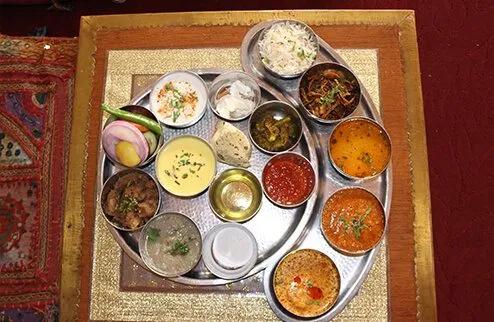
What is on the Sampoorna Rajasthani Thali at Virasat
Virasat Heritage Restaurant has served
Jaipur since 2006 on Delhi Road, Kukas. Its signature Sampoorna Rajasthani
Thali comes in a brass plate, is refilled as many times as you like, and brings
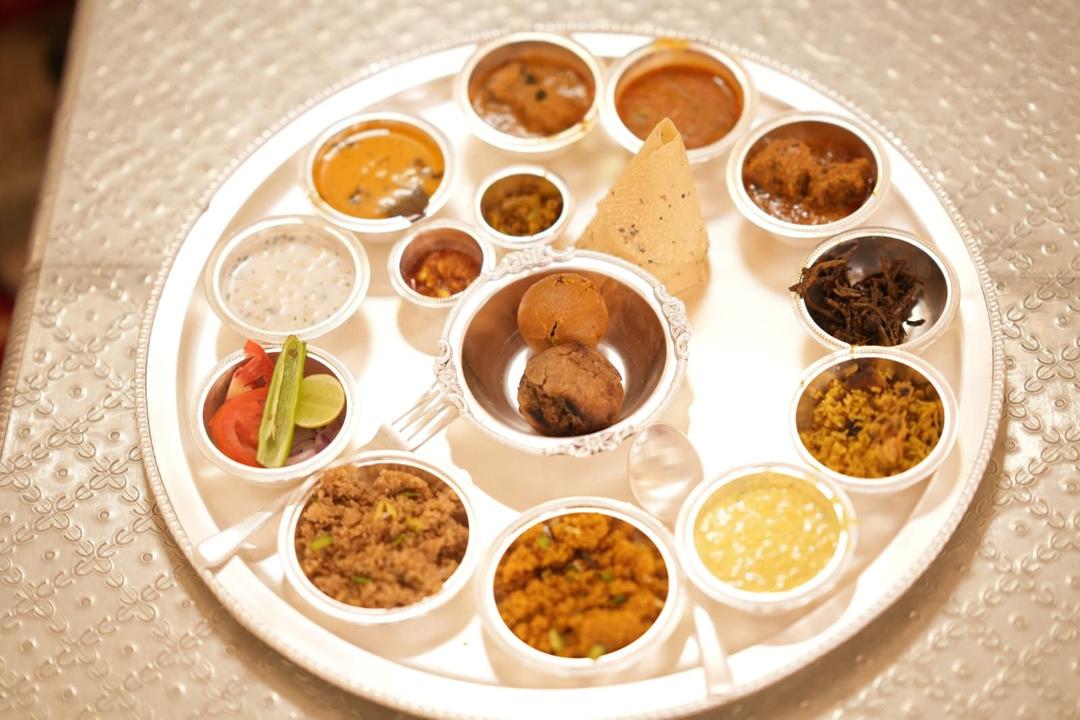
together more than 25 delicacies. Here is what the live menu lists, course by course.
|
Course |
What
is on the thali |
|
Snacks |
Pyaaz ki kachori, mirchi vada |
|
Main
thali |
Dal baati churma (baked wheat baati,
panchmel dal, sweet churma), Jodhpuri gatte ki sabzi, ker sangri, seasonal
sabzi, Rajasthani kadhi, dal, steamed rice or bajra khichdi |
|
Breads |
Bajra roti, missi roti, makki roti,
phulka with white butter |
|
Accompaniments |
Lehsun chutney, mirchi ke tipore, papad,
pickles, salad, chaas |
|
Desserts |
Malai ghewar, fini, moong thal, churma,
moong dal halwa or malpua (seasonal) |
The unlimited thali is priced at
approximately ₹2,000 to ₹3,000 per person at Swarn Mahal, where it
comes with live folk music and dance. If you want a single-serve plate, the
menu also lists à la carte thalis at ₹1,100 to ₹1,490, including the Churma Dal
Bati Thali, the Marwadi Thali and the Virasat Royal Thali. Prices and seasonal
items can change, so check the menu or call before you visit. For a
Marwar-style meal, try Jodhana,
and for a quick village-style churma dal baati thali in clay bowls, visit The Jaipar. For the full
story of this plate, read our guide to the Rajasthani
thali in Jaipur and Taste of Royal
Rajasthan.
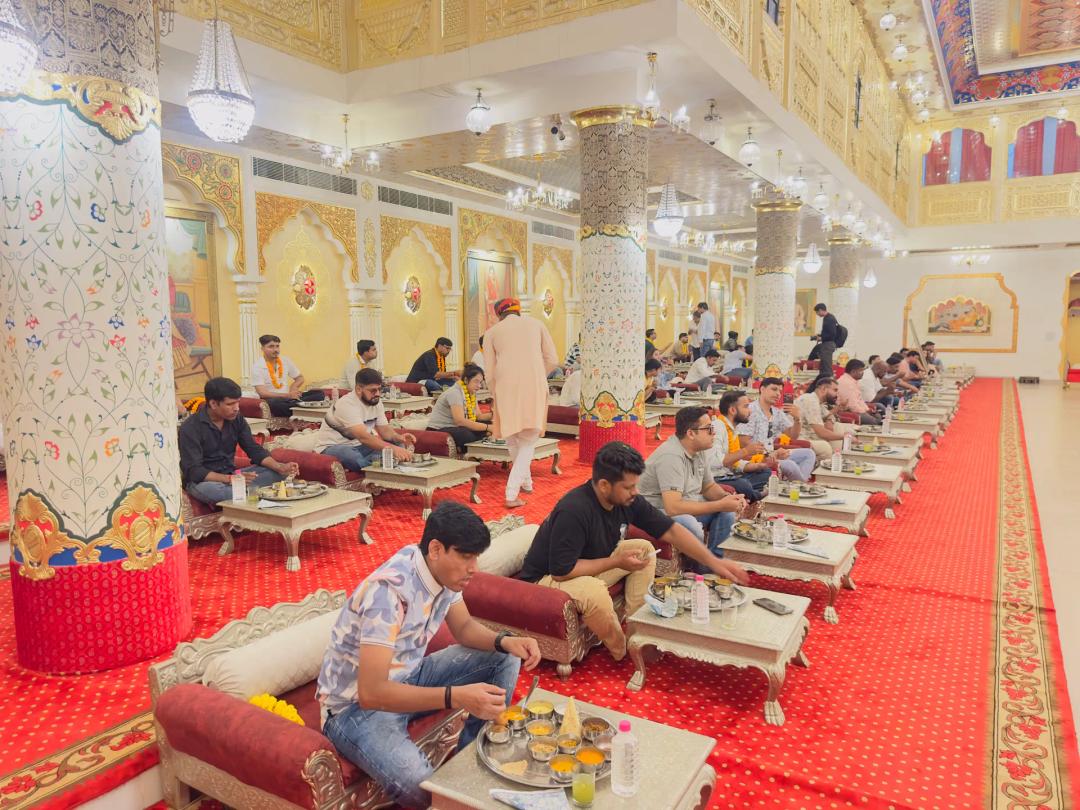
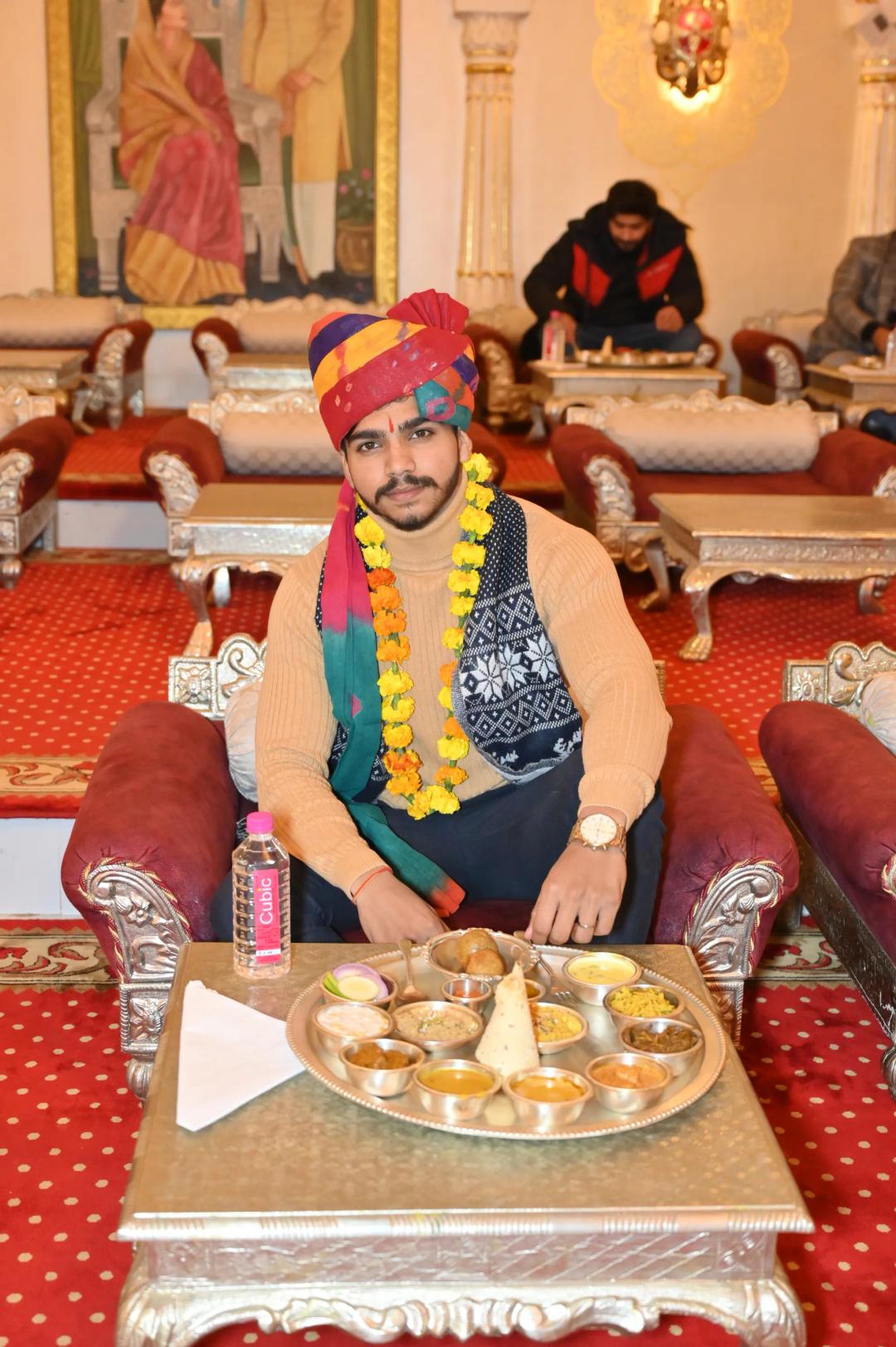
It is also a thali with a ritual. Guests
are welcomed with a tilak, a garland and a Padharo
Mhare Des greeting, then seated on low bajot seats in the darbar hall while
turbaned attendants serve and folk musicians perform. If that sounds like your
kind of evening, our guides to royal hospitality
in India and folk
performance with dinner in Jaipur explain what to expect.
If you love a Gujarati thali, here is how to order at
Virasat
Virasat does not serve a Gujarati thali,
but if that is the plate you grew up on, you will still find your way around
the Rajasthani one. A few tips:
•
Treat the snacks as your farsan. Start
with the pyaaz kachori and mirchi vada, then move to the main thali.
•
Go for kadhi. Rajasthani kadhi is tangy
and comforting, and a good bridge between the two cuisines. Ask for a second
round.
•
Take your sweet with the savoury. Mix a
little churma into your dal baati, the way some people do, and you get that
sweet-and-savoury balance in a Rajasthani way.
•
Go slowly with the garlic chutney. Taste
a little before you commit.
•
Finish with ghewar, moong thal or malpua, depending on the season.
•
Need Jain food? A Jain thali (no onion,
no garlic) is available on request. Tell your attendant when you order. Our
page on the best
vegetarian restaurant in Jaipur has more.
So which thali should you order?
•
Order the Rajasthani thali if you want
to taste where you are: ghee, baati, gatte, ker sangri and a hit of garlic
chutney.
•
Order a Gujarati thali if you like
lighter food, many small dishes and a touch of sweetness. Look for it in
Gujarat or at a dedicated Gujarati thali restaurant.
•
Can't decide, or travelling with a mixed group? Read our guide to Rajasthani
thali vs modern multi-cuisine dining. Virasat's menu also includes North
Indian, Chinese and continental dishes, so everyone at the table finds
something. See why families pick us as the best family
restaurant in Jaipur.
Frequently Asked Questions
What is the main difference between a Rajasthani thali and
a Gujarati thali?
A Rajasthani thali is richer and drier,
built on ghee, baati, gram flour and desert ingredients. A Gujarati thali is
lighter and more varied, with a mild sweetness and a separate snack course
called farsan.
Which thali is sweeter?
The Gujarati thali. Jaggery or sugar is
often added to dal, kadhi and some vegetables. In a Rajasthani thali, the
sweetness mostly arrives at the end, through churma, ghewar and malpua.
Which thali is spicier?
Rajasthani is usually bolder, but the
Mathania chilli adds more colour and aroma than raw heat. Some Gujarati
regional styles, such as Kathiawadi and Surti, are also spicy.
Is a Rajasthani thali vegetarian?
The everyday thali is vegetarian: dal baati
churma, gatte ki sabzi, ker sangri and kadhi. At Virasat, the whole restaurant
is 100% pure vegetarian.
Is a Gujarati thali always vegetarian?
Traditionally, yes. The cuisine is largely
vegetarian, shaped by Jain and Vaishnav culture.
What is in a Rajasthani thali?
Usually dal baati churma, gatte ki sabzi,
ker sangri, panchmel dal, bajra or missi roti, kadhi, chutneys, pickles and a
sweet. See the full list from Virasat's thali
menu.
What is in a Gujarati thali?
Usually dal, kadhi, two or three shaak,
rotli or bhakri, rice or khichdi, farsan like dhokla, chaas, pickles and a
sweet such as shrikhand.
Which thali is healthier?
Neither is a diet plate. The Gujarati thali
is lighter, while the Rajasthani one is heavier because of ghee and baati. Both
balance protein, carbohydrate and vegetables.
Where can I eat an unlimited Rajasthani thali in Jaipur?
Virasat Heritage Restaurant, Delhi Road,
near Sai Baba Temple, Kukas, Jaipur, serves an unlimited Sampoorna Rajasthani
Thali with live folk music and dance. It is open 11 AM to 11 PM every day and
is about 15 minutes from Amer Fort. Read about the Rajasthani
restaurant in Jaipur.
Does Virasat serve Gujarati thali?
No. Virasat serves a Rajasthani thali, plus
North Indian, Chinese and continental dishes. Everything is 100% pure
vegetarian.
Can I get a Jain thali?
Yes. A Jain thali (no onion, no garlic) is
available at Virasat on request. Tell your attendant when you order.
How much does a Rajasthani thali cost at Virasat?
The unlimited thali is approximately ₹2,000
to ₹3,000 per person at Swarn Mahal, and à la carte thalis start at ₹1,100.
Prices can change, so check the menu
or call +91 73749 99951.
Hinglish
quick answer (rajasthani thali aur gujarati thali me antar): Rajasthani thali me ghee, baati aur dessert ingredients zyada hote
hain, to wo heavy aur bold hoti hai. Gujarati thali halki, variety wali aur
thodi meethi hoti hai.
Final Thoughts
The Rajasthani thali and the Gujarati thali
are two answers to the same question: how do you feed a guest well? One answers
with ghee, baati and the desert's patience. The other answers with balance,
sweetness and a parade of small dishes. Neither is wrong, and the best way to
understand the difference is to eat both.
If you are in Jaipur, start with the Rajasthani plate. Reserve a table at Virasat, come hungry, and let the attendants do the rest. For more on what to order, read our guide to authentic Rajasthani food you must try in Jaipur. Or call +91 73749 99951.
Related reading
Eco-Friendly Diwali in Jaipur 2026: 12 Green Ideas, a 5-Day Plan and a Royal Diwali Dinner
Diwali 2026 falls on Sunday, 8 November, with Dhanteras on Friday, 6 November. An eco-friendly Diwali in Jaipur means clay diyas instead of plastic lights, natural rangoli, handmade local gifts, folk music instead of loud firecrackers and a festive meal that does not create a mountain of waste. If you would rather spend the evening at a table than in a kitchen, Virasat Heritage Restaurant in Kukas offers a pure vegetarian Rajasthani Diwali dinner in palace-style halls with live folk culture. Jaipur does Diwali better than most cities. The old bazaars glow, the sweet shops run out of mawa kachori by noon and every terrace seems to have its own row of lamps. The one thing the city does not need more of is smoke, noise and plastic. This guide shows you how to keep every bit of the glow and cut most of the mess.
Amer Fort Light and Sound Show: Timings, Tickets and a Dinner Plan
The Amer Fort light and sound show runs every evening below the fort, facing Maota Lake, in two shows: English first, Hindi second. From October to February the English show starts at 6:30 PM and the Hindi show at 7:30 PM, and each lasts about 50 to 55 minutes. Tickets are separate from the fort entry ticket. Plan dinner for after the show, and if you want a proper Rajasthani meal, Virasat Heritage Restaurant is a pure vegetarian restaurant near Amer Fort, about twenty minutes away in Kukas and open until 11 PM. Most people see Amer Fort in daylight, squinting at the sandstone and dodging selfie sticks. The evening version is a different animal: the crowds thin out, the walls glow gold and the story of the Kachwaha rulers is told in light and music on the fort's own face. It is one of the few things in Jaipur that works equally well for couples, families and solo travellers.
Baby Shower Venues in Jaipur: 6 Royal Halls, Garden and Banquet Near Kukas
Picture it: a red carpet, a tilak on the forehead, rose petals on the floor and a hall that glows like a palace. Your family walks in, the mother-to-be is welcomed like a rani, and the party has not even started. That is what a royal baby shower in Jaipur can feel like when the venue does half the work for you. The short version: If you are comparing baby shower venues in Jaipur and want something truly royal, Virasat Heritage Restaurant in Kukas gives you six distinct settings under one roof: four palace-style dining halls, a banquet hall and a garden lawn. Every plate is pure vegetarian, every guest gets a traditional welcome and folk culture is part of the evening. Pick the hall that matches your mood, book early and let the setting carry the theme.
Visit Virasat Heritage Restaurant
Experience the royal dining we write about.