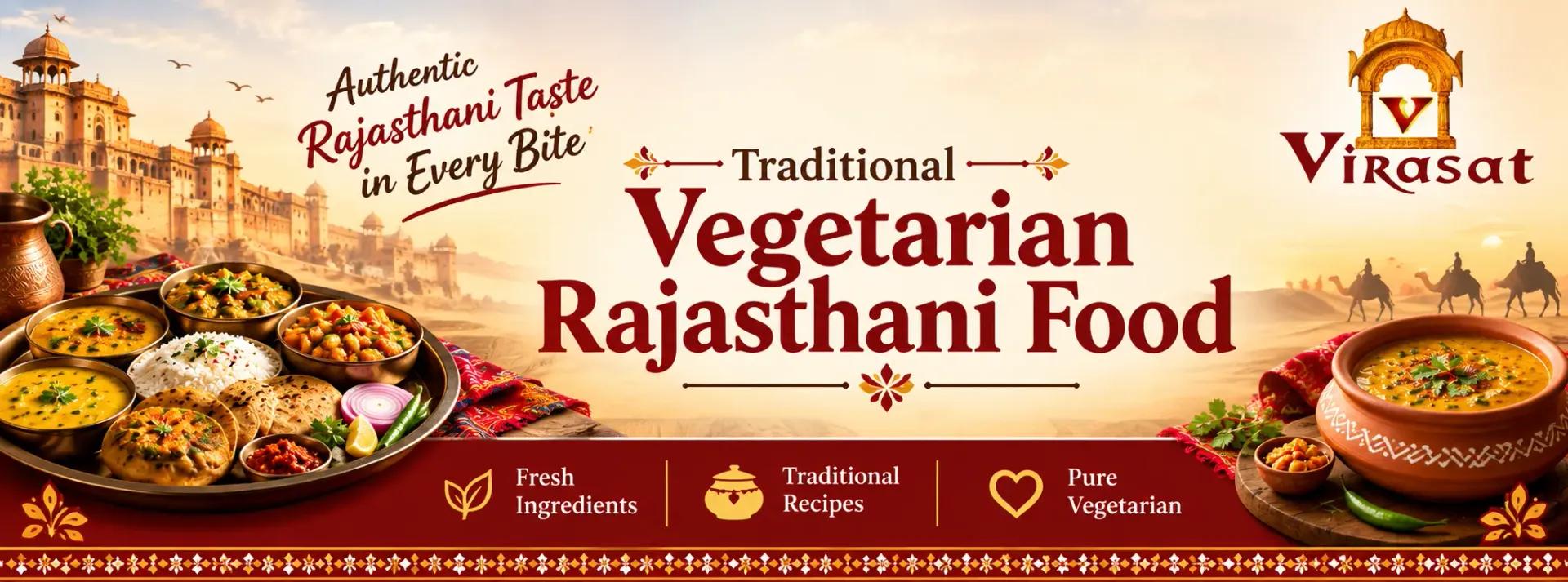
Traditional Vegetarian Rajasthani Food
Introduction: Why Rajasthani Vegetarian Food Is Unlike Anything Else in India
Rajasthan, the Land of Kings, is home to one of India’s most extraordinary vegetarian cuisines. Born from the harsh Thar Desert, shaped by centuries of royal tradition, and sustained by Jain, Brahmin, and Marwari communities, traditional vegetarian Rajasthani food is a masterclass in flavour without fresh vegetables.
With over 74.9% of Rajasthan’s population being vegetarian (the highest in India), this cuisine is built on pantry staples: gram flour (besan), dried lentils, bajra (pearl millet), dried berries, and rivers of golden ghee. The result? Dishes that are bold, satisfying, shelf-stable, and deeply nutritious.
In this guide, we explore the best traditional veg Rajasthani dishes, the history behind them, how to eat them authentically, and where to find them whether you’re in Jaipur, Jodhpur, or your own kitchen.
🏰 The History & Culture Behind Veg Rajasthani Cuisine
Rajasthani vegetarian cuisine didn’t emerge by chance. Three powerful forces shaped it:
- The Desert Environment: The Thar Desert’s scarcity of water and fresh produce forced cooks to rely on dried legumes, gram flour, and long-lasting ingredients. Dishes had to survive days of travel without refrigeration.
- Royal & Temple Traditions: Brahmin, Jain, and Marwari communities influenced meat-free cooking deeply. The Vaishnavite tradition of offering food to deities (Naivedhya) gave rise to a rich tradition of pure veg temple cuisine elaborate, fragrant, and ghee-soaked.
- Marwari Business Community: The Marwaris, renowned traders who spread across India, carried their vegetarian Bhojnalaya (restaurant) tradition everywhere. Today, “Marwari food” is synonymous with wholesome vegetarian cooking.
The outcome is a cuisine of remarkable ingenuity: rich without cream, satisfying without meat, and intensely flavourful without a single fresh vegetable in many dishes.
🍽️ Top 15 Traditional Vegetarian Rajasthani Dishes You Must Try
These are the most iconic, most searched, and most celebrated veg dishes from Rajasthan — each with a rich story behind it.
1. Dal Baati Churma The Soul of Rajasthani Cuisine
The undisputed king of traditional Rajasthani vegetarian food. Hard wheat dough balls (baati) are baked over an open fire or in a tandoor, then cracked open and drowned in ghee. Served alongside Panchmel Dal (a five-lentil soup) and sweet, crumbly Churma (coarsely ground wheat with jaggery), this is the dish that defines Rajasthan on every dining table.
- Why It Ranks: Dal Baati Churma is the #1 most-searched Rajasthani dish globally.
- Nutritional Highlight: High in protein (dal), complex carbs (baati), and healthy fats (ghee).
- Best Eaten: At traditional dhabas or heritage restaurants in Jaipur, Jodhpur, or Jaisalmer.
2. Gatte Ki Sabzi The Pantry Genius
Steamed gram flour (besan) dumplings, sliced and simmered in a tangy yoghurt-based gravy. Gatte ki Sabzi was born out of necessity when fresh vegetables were unavailable; cooks turned to the pantry. Today it is one of the most beloved and searched Rajasthani veg recipes worldwide.
- SEO Opportunity: “gatte ki sabzi recipe” is a low-competition, high-traffic keyword perfect for food blogs.
- Serving Style: Best with bajra roti, missi roti, or steamed rice.
3. Ker Sangri The Desert Pickle-Curry
A tangy, spicy stir-fry made from dried desert berries (ker) and long desert beans (sangri), both foraged from the arid landscape of western Rajasthan. Ker Sangri can be made dry or with a little gravy and stores beautifully for days. It is a dish of pure survival turned into pure pleasure.
4. Rajasthani Kadhi Bold & Tangy
Unlike the sweet Gujarati kadhi, Rajasthani kadhi is tangier, spicier, and more robust — made with thick yoghurt and besan, tempered with mustard seeds, dried red chillies, and a heavy hand of hing (asafoetida). Served with rice, bajra khichdi, or rotis.
5. Rajasthani Thali The Complete Experience
A traditional Rajasthani veg thali is the most authentic way to experience the cuisine. A typical thali includes baati, panchmel dal, gatte ki sabzi, ker sangri, rajasthani kadhi, bajra roti, missi roti, churma ladoo, papad, achaar, and lassi.
6. Bajra Ki Roti with Lehsun Chutney
Pearl millet flatbread served hot off the tawa with white butter (makhan) and a fiery garlic-chilli chutney. A staple of rural Rajasthan, bajra roti is now celebrated as a healthy, gluten-free alternative loved by food enthusiasts and health bloggers alike.
7. Panchmel Dal (Panchratna Dal)
A protein powerhouse made by combining five lentils chana dal, moong dal, toor dal, urad dal, and masoor dal with a bold tempering of ghee, jeera, and whole spices. The five-lentil combination is nutritionally complete and deeply flavourful.
8. Pyaaz Ki Kachori — The Street Food King
A flaky, deep-fried pastry stuffed with a spiced onion filling. The Pyaaz Kachori is a Jodhpur specialty and one of Rajasthan’s most beloved street snacks. Best eaten hot with green chutney and tamarind chutney.
9. Mirchi Bada
Large, plump green chillies dipped in a spiced gram flour batter and fried golden. A must-try street snack from Jodhpur. Often stuffed with a tangy potato filling. Served with a sweet tamarind chutney.
10. Raj Kachori
A giant, crispy fried pastry shell filled with sprouts, yoghurt, chutneys, sev, and pomegranate seeds. Called the “King of Chaats” Raj Kachori is a celebration in a single bowl.
11. Ghevar — The Royal Sweet
A disc-shaped, honeycomb-textured sweet made with flour, ghee, and sugar syrup, topped with rabri (thickened cream) and nuts. Ghevar is deeply seasonal traditionally made during Teej and Raksha Bandhan and is one of Rajasthan’s most iconic desserts.
12. Moong Dal Halwa
A slow-cooked, intensely rich winter halwa made from ground moong dal roasted in ghee until golden. One of the most labour-intensive and beloved sweets of Rajasthan — served at weddings, festivals, and celebrations.
13. Churma Ladoo
Coarsely ground wheat fried in ghee, mixed with jaggery or sugar, nuts, and cardamom, and rolled into round laddoos. The sweet companion to Dal Baati, Churma ladoos appear at every festive Rajasthani table.
14. Malpua
Soft, fluffy pancakes made with flour, semolina, and fennel, deep fried and soaked in fragrant sugar syrup. Served with rabri. A popular dessert during Holi and other festivals.
15. Papad Ki Sabzi
Broken roasted papad cooked in a spiced yoghurt gravy. Another example of Rajasthan’s genius for creating full-flavoured dishes from humble pantry ingredients. Quick to make and deeply satisfying.
FAQ Section (Target Featured Snippets)
Adding an FAQ section targeting common search questions helps capture Featured Snippet positions on Google, which can dramatically increase click-through rates.
Q: What are the most popular traditional vegetarian Rajasthani dishes?
A: The most popular traditional vegetarian Rajasthani dishes are Dal Baati Churma, Gatte Ki Sabzi, Ker Sangri, Rajasthani Kadhi, Panchmel Dal, Bajra Ki Roti, Pyaaz Ki Kachori, and Ghevar. These dishes form the backbone of authentic veg Rajasthani cuisine.
Q: Is Rajasthani food mostly vegetarian?
A: Yes. According to a 2014 survey by the Registrar General of India, Rajasthan has 74.9% vegetarians the highest percentage of any Indian state. Most traditional Rajasthani cuisine is vegetarian, shaped by Jain, Brahmin, and Marwari communities.
Q: What makes Rajasthani vegetarian food unique?
A: Rajasthani veg food is unique because it creates bold, complex flavours without fresh vegetables. The cuisine relies on gram flour (besan), dried lentils, preserved desert produce (ker, sangri), dairy (ghee, yoghurt, buttermilk), and strong spices to produce dishes that are nutritionally complete and intensely satisfying.
Q: What is a traditional Rajasthani veg thali?
A: A traditional Rajasthani veg thali typically includes: baati (wheat balls), panchmel dal, gatte ki sabzi or ker sangri, rajasthani kadhi, bajra roti, missi roti, churma ladoo, papad, pickle, and lassi. It is usually unlimited (refills upon request) and served in brass or silver katoris.
Q: Where is the best place to eat vegetarian Rajasthani food in Jaipur?
A: The best places in Jaipur for authentic veg Rajasthani food include Rajasthani Bhog (Bani Park), Chokhi Thali (near Hawa Mahal), The Vintage Kitchen (Amer), Govindam Retreat (near City Palace), and Thali & More (C Scheme). For a luxury experience, Suvarna Mahal at Taj Rambagh Palace and 1135 AD at Amber Fort are unmatched.
Q: What is Dal Baati Churma?
A: Dal Baati Churma is the signature dish of Rajasthan. It consists of three elements: Bati (hard-baked wheat balls drowned in ghee), Dal (Panchmel Five-lentil curry), and Churma (coarsely ground wheat sweetened with jaggery and ghee). It originated as warrior food and is now the most recognised Rajasthani dish worldwide.
🌿 Health Benefits of Traditional Veg Rajasthani Food
Beyond taste, traditional veg Rajasthani food offers significant nutritional benefits a growing search interest area with terms like “healthy Rajasthani food” gaining traction:
- High Protein: Panchmel dal, gatte ki sabzi, moong dal halwa, and mangodi are packed with plant protein from lentils and gram flour.
- Probiotic-Rich: Rajasthani cuisine’s heavy use of yoghurt-based curries (kadhi, gatte) and lassi supports gut health.
- Gluten-Free Options: Bajra roti, ker sangri, and most dal dishes are naturally gluten-free, making them popular with health-conscious audiences.
- Energy-Dense: Ghee, used liberally, is rich in fat-soluble vitamins (A, D, E, K) and provides sustained energy essential in the harsh desert climate.
- Low Food Waste: Many dishes use dried, preserved, or fermented ingredients, making them environmentally sustainable and pantry-friendly.
Conclusion: A Cuisine Worth Exploring and Writing About
Traditional vegetarian Rajasthani food is not just a regional cuisine it is a living archive of desert survival, royal indulgence, and community cooking. From the smoky baatis of a village fire pit to the silver thalis of a Jaipur heritage restaurant, every dish carries centuries of history in its first bite.
For food lovers, it is an adventure in bold, deeply satisfying flavours. For content creators and food bloggers, it is an SEO goldmine a topic with vast search volume, passionate audiences, and still-growing interest from travellers, home cooks, and food explorers worldwide.
Whether you are writing a recipe blog, planning a trip to Jaipur, or simply looking for your next meal, traditional vegetarian Rajasthani food will never disappoint.