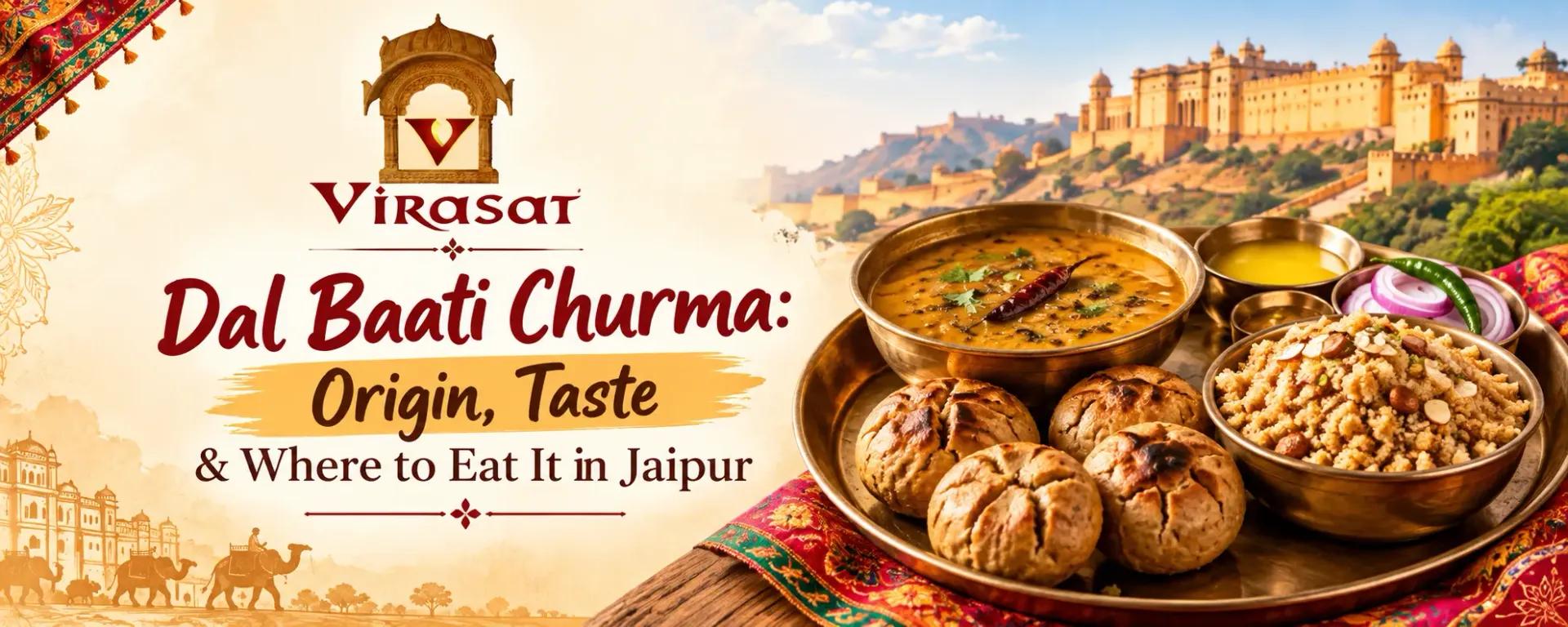
Dal Baati Churma: Origin, Taste and Where to Eat It in Jaipur
Dal baati churma is a traditional vegetarian meal from Rajasthan made of three parts: baati (baked whole-wheat dough balls dipped in ghee), dal (usually a blend of five lentils called panchmel dal) and churma (a sweet mix of crushed baati, ghee and jaggery or sugar). The baati is believed to date back to the Mewar kingdom. You eat it by breaking the baati, pouring hot dal over it and adding more ghee.
Dal baati churma is Rajasthan's most-loved meal: a crisp, ghee-soaked wheat baati, a steaming bowl of spiced panchmel dal, and a sweet, crumbled churma on the side. If you are visiting the Pink City, this is the dish people will ask you about first, and the one you are most likely to remember after you leave.
This guide
explains what the dish is, how it began, what it tastes like, and how to eat it so your first plate doesn't feel like a puzzle. You will also find a short
checklist of what to look for when you eat dal baati churma in Jaipur.
|
Dish at a glance |
|
|
Cuisine and region |
Rajasthani; closely linked with
Mewar and found across Marwar and the rest of the state |
|
Diet |
Vegetarian |
|
Main ingredients |
Coarse wheat flour, desi ghee,
mixed lentils, whole spices, jaggery or sugar, cardamom |
|
Taste profile |
Smoky and nutty (baati), peppery
and garlicky (dal), sweet and fragrant (churma) |
|
Usually served with |
Garlic chutney, sliced onion,
green chilli, kadhi or buttermilk, extra ghee |
|
Best for |
A slow, hearty lunch or early
dinner; first-time visitors who want an authentic Rajasthani thali experience |
What Is Dal Baati Churma?
It is a classic
Rajasthani meal built from three preparations that are meant to be eaten
together. Nothing about it is delicate. Every part is made to be filling,
long-lasting and rich, which is exactly what a dry, hot, battle-ready region
needed from its food.
People often
search for “rajasthani dal baati” or just “dal baati” and mean the same thing.
The word churma is what completes the set: when churma is on the plate, the
meal is called dal baati churma. Without it, you are simply eating dal baati.
The three parts: dal, baati, churma
•
Baati: a hard-crusted ball of coarse whole-wheat
dough, baked until the surface cracks and then dipped in melted desi ghee.
Inside, it is crumbly and dense, never soft like bread.
•
Dal: most often panchmel dal, a mix of five
lentils (moong, chana, toor, masoor and urad) finished with a ghee tadka of
cumin, garlic, red chilli and other whole spices.
• Churma: coarsely crushed baati mixed with ghee, powdered jaggery or sugar and cardamom, sometimes with chopped dry fruits. It is eaten as the sweet part of the meal and is also the base of churma ladoo.
The Story Behind Rajasthan’s Most Famous Meal
Warriors, travellers and desert kitchens
Nobody can name
the exact day or the exact cook who invented it, so the history of dal baati
churma is best read as a layered tradition rather than a single event. Most
accounts agree on the order in which the three parts arrived: first the baati,
then the dal, then the churma.
According to The Better India, baati is believed to have
begun in the time of Bappa Rawal, the founder of the Mewar kingdom. The story
goes that Rajput soldiers shaped dough into rough balls and left them buried
under hot sand to bake while they were away on the battlefield. When they
returned, they dug the baatis out and ate them with ghee and curd. It was food
that needed no kitchen, very little water and almost no care.
The dal is said
to have joined later. The same account links it to traders from the Gupta
period who settled in Mewar and brought their taste for panchmel dal, a mix of
five lentils that was a favourite in royal kitchens. Wikipedia’s entry on dal bati also notes that baati was first paired with ghee
and curd before dal and churma were added.
Churma comes
with the most charming legend. Folklore credits a cook from the Guhilot clan of
Mewar, who accidentally poured sugarcane juice over baatis. The baatis turned
soft and crumbled, and the sweet mixture that resulted became churma. Another
popular story says the dish travelled to the Mughal court through Rani Jodha
Bai, where royal chefs created their own versions, including bafla.
Treat these as
food legends rather than proven history; historians do not have a dated record
for any of them. What is certain is that the dish suits the land. Baati is
baked dry, keeps well and fills you up for hours, which is why it became a
household staple and a festival favourite across both Mewar and Marwar.
How Baati, Dal and Churma Are Made: A Short Overview
This is not a
full recipe, only the shape of the process, so you can recognise a well-made
plate when you see one.
Baati: baked, then dipped in ghee
Baati dough
uses coarse whole-wheat flour, often with a little semolina for crunch, plus
ghee, salt, ajwain (carom seeds) and water. The dough is stiff, rolled into
balls and baked in a clay or tandoor-style oven, traditionally over embers or
dung cakes, until golden brown with fine cracks. A hot baati is then dipped in
melted ghee so the fat soaks into the crumb. That dip is what separates a
proper baati from a dry roll.
Panchmel dal and the tadka
Five lentils
are boiled together until soft and then finished with a tadka: ghee heated with
cumin, hing, cloves, dried red chilli, garlic and ginger. The dal is usually
thinner and more peppery than everyday dal because its job is to moisten the
dense baati, not to compete with it.
Churma: sweet and crumbled
Baked baati is
crushed to a coarse crumb, then mixed with ghee, jaggery or sugar and cardamom.
The result should be grainy, fragrant and only moderately sweet. In some homes,
churma is made from bajra or semolina instead of wheat, and it can be rolled into
churma ladoo for festivals.
What Does It Taste Like?
The best way to
understand this dish is to see it as a plate of contrasts. The baati is nutty,
slightly smoky and rich with ghee. The dal is warm, peppery and garlicky. The
churma is sweet and cardamom-scented, with a gritty crumb that cuts through the
heat of the dal. A spoonful of garlic chutney adds a sharp, fiery edge, and raw
onion gives a clean, crunchy reset between bites.
If you have
never eaten it before, expect it to be heavier than most Indian meals. The
flavour is bold but not complicated, and it improves with every extra spoon of
dal and ghee.
How to Eat Dal Baati the Right Way
There is no
wrong way to enjoy it, but there is a traditional method that makes the most of
how the dish is built.
Crush, ladle, add ghee
1.
Crush the baati. Press it gently with your palm
or tap it on the plate until it cracks open. Do not cut it with a knife.
2.
Ladle the dal. Pour hot panchmel dal over the
broken baati and let it soak for a few seconds.
3.
Add ghee. Ask for an extra spoon of warm ghee on
top. Eating dal baati churma with ghee is the entire point; do not skip it.
4.
Mix in the sides. Take a little garlic chutney,
a bite of onion or some green chilli along with each mouthful.
5.
Finish with churma. Some families eat the churma
at the end as dessert, and others take a spoonful between savoury bites. Both
ways are correct.
One practical tip: start with one baati and add a second only if you still have room. In Rajasthan, hosts consider it good hospitality to keep serving, so pace yourself and say so politely when you have had enough.
Dal Baati Churma vs Dal Bafla
Dal bafla is
the softer cousin of baati. A bafla is boiled first and then baked, which makes
the inside tender and the crust less hard. It is especially popular in the
Malwa region of Madhya Pradesh. Here is how they compare:
|
|
Dal baati churma |
Dal bafla |
|
Cooking method |
Baked directly |
Boiled, then baked |
|
Texture |
Firm crust, dense and crumbly
inside |
Softer, tender and moist |
|
Region |
Rajasthan, with Mewar origin
stories |
Malwa (Madhya Pradesh) and nearby
areas |
|
Sweet pairing |
Churma is the standard partner |
Usually served with ghee and dal;
churma is optional |
|
Best for |
People who like crunch and a
smoky flavour |
People who prefer a softer bite |
You may also
hear about litti chokha, the baked, sattu-stuffed dough balls of Bihar and
eastern Uttar Pradesh. They look similar, but litti is stuffed and served with
mashed vegetables, not dal and churma.
Where to Eat Dal Baati Churma in Jaipur
Jaipur serves
this dish in everything from roadside stalls to royal-style dining rooms, so
the better question is not “where” but “how do I know it is good?” Use the
checklist below, and you will be able to judge any plate.
What makes a good serving
•
The baati is cracked and golden, not pale or
rubbery, and it is served hot.
•
Ghee is generous and fresh. You should smell it
before you taste it, and it should come in a bowl or spoon so you can add more.
•
The dal is a real panchmel blend with a visible
tadka, not a thick, one-lentil gravy.
•
The churma is grainy and balanced, with cardamom
and a sweetness that does not overpower the meal.
•
Garlic chutney, onion and kadhi or chaas come on the
side, because they are part of the experience.
•
The setting matches the food. The meal tastes
better when you can sit, slow down and enjoy it.
Dal baati churma in the Virasat thali
If you want to
eat it the traditional way, you can try dal baati churma as part of a full
Rajasthani meal at Virasat. The dish sits alongside other regional
specialities, so you can taste how the baati, dal and churma fit into a
complete Rajasthani thali. You can look at the dal baati churma on the menu to see what is currently served, and reserve a table if you would like to plan your meal.
To see how the
dish fits with the rest of the cuisine, read our guide to vegetarian Rajasthani dishes, or explore the
wider Rajasthani food in Jaipur guide. This article
is about the dish itself, while those pages cover the full meal. If you enjoy
dining in a setting that matches the food, the Swarn Mahal dining hall is worth a look.
Frequently Asked Questions
Is dal baati churma healthy?
It is a
balanced but calorie-dense meal. Whole-wheat baati and five lentils give you
fibre and plant protein, while the ghee and sweetened churma add a lot of
energy. Enjoy it as a hearty occasional meal, keep to one or two baatis, and
ask for a little less ghee or churma if you want a lighter plate. If you manage
diabetes or another health condition, check with your doctor or dietitian
first.
Is it served for lunch or dinner?
Traditionally
it is a heavy, satisfying meal, so many people prefer it at lunch or as an
early dinner. In Jaipur, restaurants usually offer it at both times, though
baati is best eaten fresh and hot.
Is Rajasthani dal baati vegetarian?
Yes. The
traditional version is fully vegetarian. It uses wheat, lentils, ghee, spices
and jaggery or sugar, with no meat or egg.
What is churma made of?
Churma is made
of crushed baati (or coarse wheat, bajra or semolina flour), ghee, jaggery or
sugar and cardamom, often with chopped nuts. It is the sweet part of the meal.
How many baatis should I eat?
Most
first-timers are comfortable with one or two. Baati is dense and soaked in
ghee, so it fills you up faster than it looks.
Final Thoughts
Dal baati
churma is more than a Rajasthani favourite: it is a story of soldiers, traders,
royal kitchens and household kindness, all in one plate. Understand the three
parts, eat it with the right amount of ghee, and it will make sense from the
first bite. When you are in Jaipur, give yourself time for a slow meal, and let
the baati, dal and churma do the talking. To plan your visit, check the menu or book a table.