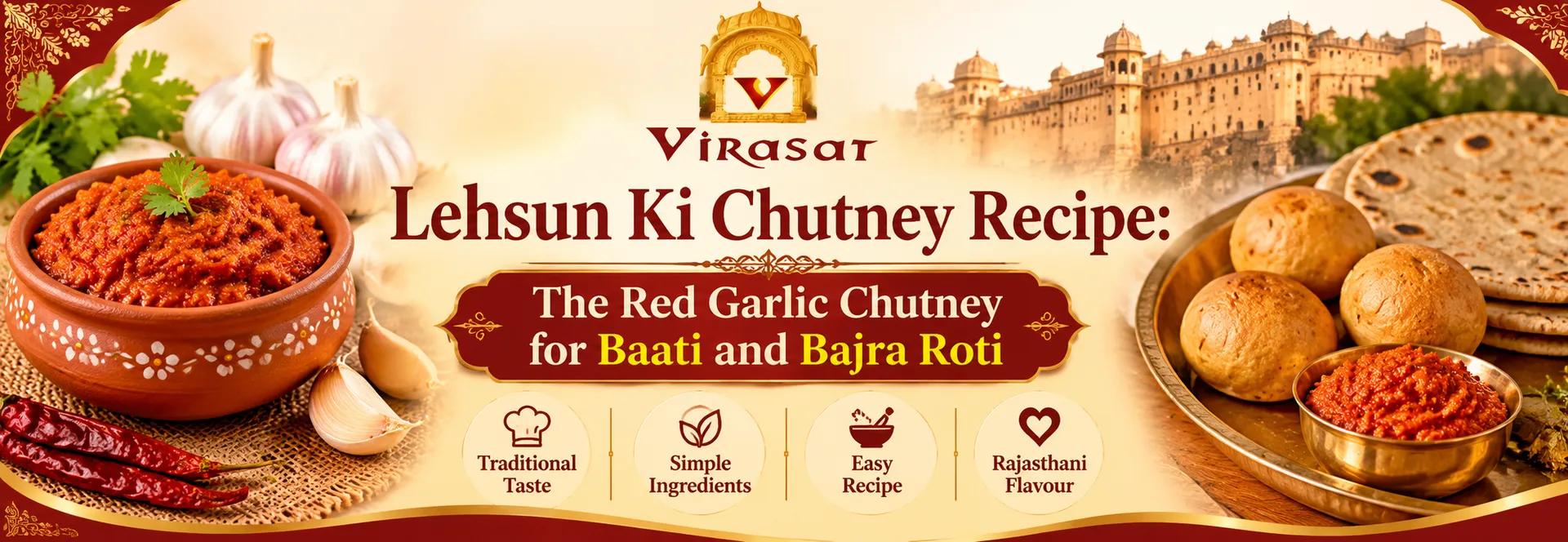
Lehsun Ki Chutney Recipe: The Red Garlic Chutney for Baati and Bajra Roti
Quick answer: Lehsun ki chutney is a fiery Rajasthani red garlic chutney made by
crushing fresh garlic with soaked dried red chillies, salt and a little cumin.
For about four people, use 20 garlic cloves, 10 dried red chillies,
three-quarters of a teaspoon of salt, half a teaspoon of cumin and a teaspoon
of lemon juice. Crush it coarse, finish with a spoon of oil or ghee, and serve
it with dal baati churma, bajra roti or kachori. For a version that keeps
longer, cook the paste briefly in oil.
Some foods are not side dishes. They are
the reason you finish the main dish. In a Rajasthani meal, lehsun ki chutney is
one of them: a small, red, fierce spoonful that wakes up a ghee-soaked baati
and turns a plain bajra roti into something you remember.
This guide gives you the recipe, but also
the reasoning: how to pick chillies for colour and heat, why salt goes in
first, what to do when it turns bitter and how to store garlic chutney safely.
Read it once, and you will not need to look up another lasun chutney recipe
again.
Recipe snapshot
|
Detail |
Value |
|
Dish |
Lehsun ki chutney (Rajasthani red garlic
chutney) |
|
Prep time |
10 minutes, plus 15 minutes to soak the
chillies |
|
Cook time |
None for the raw version, 6 to 8 minutes
for the tempered version |
|
Makes |
About half a cup, enough for 4 people |
|
Heat level |
Medium-hot to hot, adjustable |
|
Diet |
Vegetarian and vegan. Contains garlic, so
it is not suitable for Jain or no-garlic diets. |
|
Best with |
Dal baati churma, bajra roti, kachori,
mirchi vada, khichdi |

What is lehsun ki chutney, and why is it red?
Lehsun (also spelled lahsun or lasun)
simply means garlic. The red colour comes from dried red chillies, soaked and
crushed together with the garlic. In many Rajasthani homes, the chutney is made
on a sil-batta (a stone slab and pestle) so the garlic and chillies break down
into a rough, juicy paste instead of a smooth purée.
Rajasthan is known for its dry-climate
cooking: dried chillies, dried vegetables, pulses and grains stored for months.
A chutney made from garlic and dried chillies fits that tradition perfectly,
because both ingredients are pantry staples that need no refrigeration to begin
with.
Ingredients (for about half a cup)
Core ingredients
|
Ingredient |
Quantity |
Why
it matters |
|
Garlic cloves, peeled |
20 (about 50 g) |
The body of the chutney. Fresh, firm
cloves taste sweeter. |
|
Dried red chillies |
10 (about 15 g) |
Colour and heat. See the chilli guide
below. |
|
Salt |
3/4 teaspoon |
Draws moisture out of the garlic and
helps it break down. |
|
Cumin seeds |
1/2 teaspoon |
Adds warmth and balances the sharpness. |
|
Lemon juice |
1 teaspoon |
Brightens the flavour at the end. |
|
Oil or ghee |
1 tablespoon (raw) or 2 tablespoons
(tempered) |
Rounds out the heat and carries the
flavour. |
|
Warm water (chilli soaking water) |
1 to 2 tablespoons |
Loosens the paste without diluting the
taste. |
Optional extras
•
1 teaspoon cold-pressed mustard
oil for a sharp, traditional finish (raw version).
•
1/2 teaspoon coriander seeds,
lightly dry roasted, for a citrusy note.
•
1 small ripe tomato for a
softer, juicier chutney (use within a day or two).
•
A pinch of asafoetida in the
tempering for aroma.
•
A pinch of jaggery if your
chillies taste harsh.
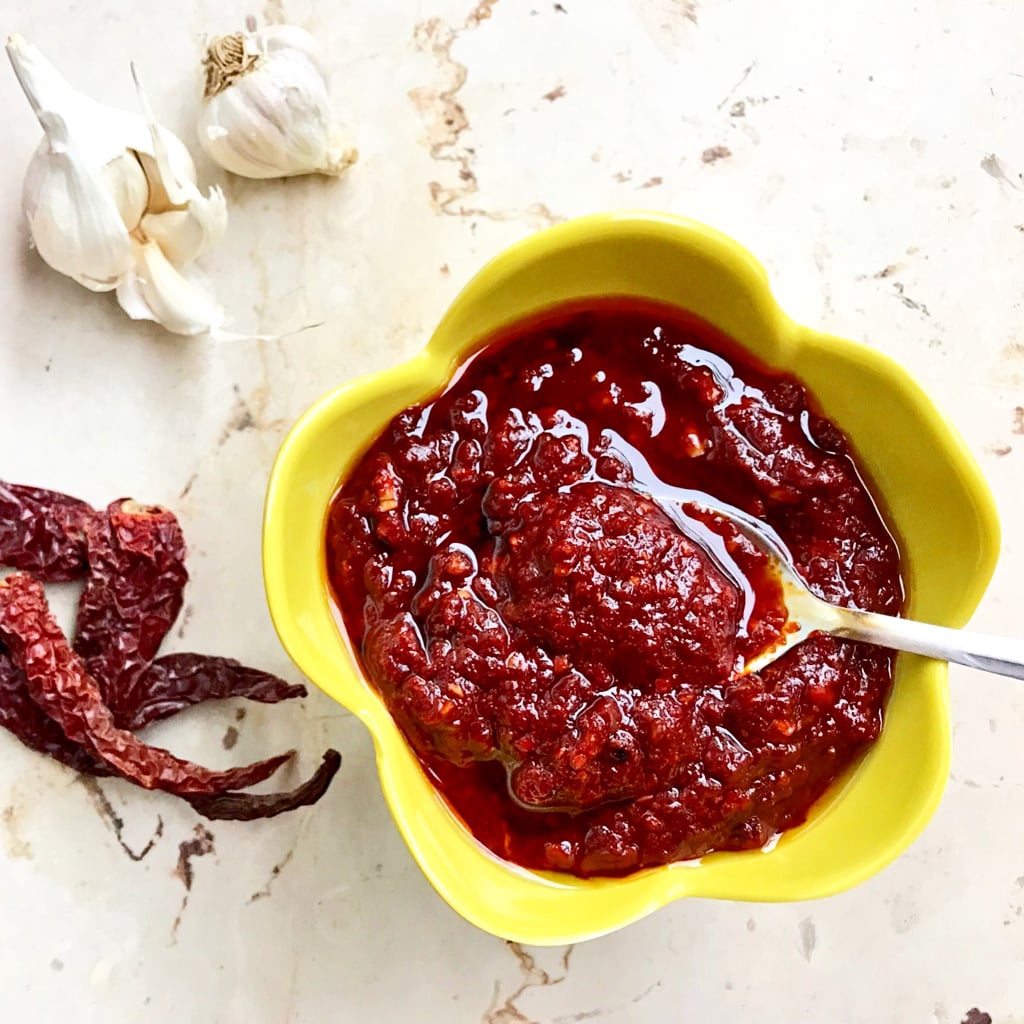
The chilli guide: colour first, then heat
The chillies decide how the chutney looks
and how it bites. Use a blend rather than a single type.
|
Chilli
type |
What
it gives you |
|
Kashmiri red chillies |
Deep red colour, mild heat |
|
Mathania or other Rajasthani red chillies |
Strong colour and noticeable heat |
|
Guntur-type hot chillies |
Sharp heat, less colour |
Spice ladder for 10 chillies:
|
Heat
level |
Blend |
|
Mild |
8 Kashmiri + 2 hot |
|
Medium (our pick) |
6 Kashmiri + 4 hot |
|
Fiery |
4 Kashmiri + 6 hot |
Remove the stems. For less heat, shake out
most of the seeds before soaking.
Why this method works (the short science)
•
Salt first. Salt pulls water from the garlic and acts as an abrasive when you
pound or grind, so the cloves break down evenly.
•
Soaking the chillies. Soft chillies crush into a paste instead of leaving tough flakes.
•
Crushing releases the bite. Garlic gets its sharpness when its cells are broken. The more
finely you crush it, the stronger the chutney tastes at first.
•
Heat mellows it. Cooking the paste in oil softens the raw edge and makes the chutney
last longer.
•
Acid balances it. A little lemon juice at the end lifts the flavour and cuts the
heaviness.
Method 1: Traditional sil-batta chutney (raw)
1.
Soak the chillies. Place the stemmed chillies in a bowl, pour hot water over them and
leave for 15 minutes until they feel soft. Drain, but keep 2 tablespoons of the
soaking water.
2.
Start with salt and garlic. In the sil-batta or a heavy mortar, add the garlic, salt and cumin.
Pound until the garlic breaks into a rough, sticky mash.
3.
Add the chillies. Add the soaked chillies and keep pounding in short, firm strokes
until the paste turns bright red and looks coarse, not smooth.
4.
Loosen if needed. Add 1 to 2 tablespoons of the soaking water, a spoonful at a time,
until it reaches a thick, spoonable texture.
5.
Finish. Stir in the lemon juice and the oil or ghee. Taste. Add salt or a
pinch of jaggery if needed.
6.
Rest for 10 minutes. The flavours settle and the raw edge softens slightly.
Method 2: Mixer-grinder shortcut

1.
Soak and drain the chillies as
above.
2.
Add garlic, salt, cumin and
chillies to a small jar.
3.
Pulse in short bursts, scraping
down the sides, until coarse. Do not run it continuously, or the heat from the
blades will make the garlic bitter and the paste too smooth.
4.
Add the soaking water a
spoonful at a time only if the jar needs help.
5.
Finish with lemon juice and
oil, and rest for 10 minutes.
Method 3: Tempered lehsun chutney (keeps longer)

1.
Make the paste with Method 1 or
2, but leave out the lemon juice for now.
2.
Heat 2 tablespoons of oil or
ghee in a small pan over low heat.
3.
Add the cumin seeds if you did
not already grind them in. Let them sizzle for a few seconds.
4.
Add the paste. Stir
continuously on low heat for 4 to 6 minutes, until the raw smell fades and the
oil begins to separate at the edges.
5.
Do not let the garlic brown. If
it browns, the chutney turns bitter.
6.
Switch off the heat, cool for 5
minutes, then stir in the lemon juice.
7.
Cool completely before storing.
Raw vs tempered: which should you make?
|
|
Raw |
Tempered |
|
Taste |
Sharp, fresh and loud |
Rounder, deeper and mellow |
|
Colour |
Bright red |
Deeper red-brown |
|
Best with |
Fresh baati, bajra roti, kachori |
Parathas, sandwiches, packed meals |
|
Keeps |
3 to 4 days in the fridge |
Up to about a week in the fridge |
|
Effort |
10 minutes |
20 minutes |
Troubleshooting table
|
Problem |
Likely
cause |
Fix |
|
Too hot |
Too many hot chillies or seeds |
Add a little more crushed garlic, a pinch
of jaggery or a spoon of ghee |
|
Bitter |
Garlic over-processed or browned |
Make a fresh small batch and mix it in.
Next time pulse, do not blend continuously. |
|
Too sharp and raw |
Not rested or not tempered |
Rest 10 minutes, or cook briefly in oil |
|
Watery |
Too much soaking water |
Spread the chutney in a pan and cook on
low heat for a few minutes |
|
Dull colour |
Mostly hot chillies, few Kashmiri |
Add 2 or 3 more soaked Kashmiri chillies |
|
Oil floats on top |
Too much oil |
Stir well or blot gently with a spoon |
How to serve lehsun ki chutney
•
With dal baati churma. Crush the baati, pour ghee over it, then add dal and a spoon of
chutney on the side. Take a bite of baati with a little chutney, not the other
way round.
•
With bajra roti. Smear a little chutney and white butter or ghee on a hot bajra roti
and roll it.
•
With kachori and mirchi
vada. The sharp garlic cuts the oil and richness.
•
In khichdi. A spoonful on top turns a plain bowl into a meal.
•
As a sandwich spread. Mix a teaspoon with curd for a quick sandwich filling.
Storage and food safety
1.
Always use a clean, dry
spoon. Moisture and crumbs spoil chutney quickly.
2.
Keep the chutney in a clean
glass jar in the refrigerator.
3.
Do not store garlic in oil
at room temperature. Garlic stored in oil can
create conditions that allow harmful bacteria to grow. Refrigerate it, and make
small batches.
4.
Use the raw version within 3 to
4 days and the tempered version within about a week.
5.
To freeze: spoon into an ice-cube tray, freeze, then store the cubes in a
sealed container for up to a month.
6.
If it smells sour, looks fizzy
or shows any mould, throw it away.
Scaling the recipe
|
Servings |
Garlic |
Dried
chillies |
Salt |
Oil
or ghee (raw) |
|
2 |
10 cloves |
5 |
1/3 teaspoon |
2 teaspoons |
|
4 |
20 cloves |
10 |
3/4 teaspoon |
1 tablespoon |
|
8 |
40 cloves |
20 |
1 1/2 teaspoons |
2 tablespoons |
For large batches, make the tempered
version and store it in small jars in the refrigerator, rather than one big jar
you open every day.
Who should be careful
This chutney is hot and garlicky. Go easy
if you have acid reflux or a sensitive stomach, and introduce it to children in
tiny amounts. It is not suitable for Jain or no-garlic diets.

Taste it the Rajasthani way at Virasat
Cooking it at home is satisfying, but
nothing replaces eating it at a table where the baati arrives hot and the ghee
is poured generously. Virasat
Heritage Restaurant is a pure vegetarian Rajasthani
restaurant in Jaipur where the Sampoorna Rajasthani Thali brings together
more than 25 delicacies, including dal baati churma, gatte ki sabzi and ker
sangri, served unlimited by turbaned attendants. See the Rajasthani thali menu for the full
spread.
[Team confirm kare: Kya lehsun ki
chutney thali ke saath rozana serve hoti hai? Agar haan to yahan ek line
likhein, jaise 'Our thali is served with a red garlic chutney on the side.']
Virasat is on Delhi Road, in
Kukas, open from 11 AM to 11 PM daily. If you are searching for a Rajasthani
restaurant near me or want dal
baati churma near me, check the route with directions
on Google Maps. It is a family
restaurant in Jaipur and a vegetarian
restaurant in Jaipur with palace-style halls and live folk culture. Browse
the gallery and reserve your table to taste the
real thing.
Call: +91
95877 77817 | Reviews: See
us on Google
Frequently Asked Questions
Q. How do you make lehsun ki chutney?
Ans. Soak dried red chillies for 15 minutes, then crush them with
garlic, salt and cumin into a coarse paste. Finish with a little lemon juice
and oil or ghee.
Q. Which red chillies are best for garlic chutney?
Ans. Use a blend. Kashmiri chillies give colour
and mild heat, while Rajasthani or other hot red chillies add bite.
Q. Why is my garlic chutney bitter?
Ans. Bitterness usually comes from over-blending or browning the garlic.
Pulse in short bursts, and keep the heat low when tempering.
Q. Can I make it without a sil-batta?
Ans. Yes. A mortar and pestle or a small mixer jar works. Pulse in short
bursts so the paste stays coarse.
Q. How long does lehsun ki chutney last?
Ans. The raw version keeps for 3 to 4 days in the refrigerator, and the
tempered version for about a week. You can also freeze it for up to a month.
Q. What do you eat Rajasthani garlic chutney with?
Ans. Dal baati churma, bajra roti,
kachori, mirchi vada, khichdi and parathas.
Q. Is lehsun chutney vegan?
Ans. Yes, if you make it with oil instead of ghee.
Q. Can Jain people eat lehsun ki chutney?
Ans. No. It is made with garlic, so it is not suitable for Jain or
no-garlic diets.
Q. Where can I eat dal baati churma in Jaipur?
Ans. Virasat Heritage Restaurant in Kukas serves
dal baati churma as part of its unlimited Rajasthani thali, in a pure
vegetarian setting.
One last spoonful
Lehsun ki chutney does not need a long list
of ingredients or a fancy technique. It needs good garlic, honest chillies, a
little salt and patience for the first bite. Make it once, and the baati will
never feel complete without it.
Related reading

Top 10 Picnic Spots in Jaipur for Family and Friends (2026 Guide)
The best picnic spots in Jaipur for family and friends are Central Park, Jawahar Circle Garden, Ram Niwas Bagh, Vidyadhar Garden, Kanak Vrindavan, the Jal Mahal lakeside, Nahargarh Fort at sunset, Amer Fort, Sisodia Rani Garden and Chandlai Lake in winter. Go between October and March for comfortable weather, carry water and light snacks, and check each place's timings and closing day before you leave. For a proper meal at the end of the day, Virasat Heritage Restaurant in Kukas serves a pure vegetarian Rajasthani thali until 11 PM.

Kitty Party Venues in Jaipur: 8 Venue Ideas, Themes, Games and a Hostess Checklist
The best kitty party venue in Jaipur is one that gives your group a private space, comfortable seating, a menu everyone can eat and enough room for games and photos. Virasat Heritage Restaurant in Kukas offers four palace-style halls, a banquet hall and a garden lawn, all with a pure vegetarian Rajasthani menu, live folk culture and a royal welcome. It suits groups from a handful of friends to a large annual get-together. It is pure vegetarian and does not serve alcohol, so it is not the place if your group wants a bar. Every kitty hostess knows the feeling. It is your turn, the group chat is asking where, and you are trying to find a place that is not too far, not too loud, not too expensive and not the same restaurant as last month. This guide is built for that moment: it covers eight venue-and-format ideas, a hall guide by group size, a theme calendar for Jaipur, games, menu tips and a countdown checklist.

Jaipur Diwali Lights 2026: Which Markets, Landmarks and Viewpoints Light Up (and When to Go)
The Jaipur Diwali lights are concentrated in the Walled City bazaars (Johari Bazar, Bapu Bazar, Nehru Bazar, Tripolia Bazar, Chaura Rasta, Kishanpole Bazar and Chandpole) and on MI Road just outside the walls. Landmarks such as Hawa Mahal, City Palace, Albert Hall and Jal Mahal look best at dusk, and Nahargarh Fort shows you the glow of the whole city from above. Go after sunset, roughly 6 to 10 PM, on foot or by metro, and avoid Diwali night itself, when many traders close early for Lakshmi Puja. That is the whole Jaipur Diwali decoration story in two lines: bazaars for the lights, landmarks for the views.
Visit Virasat Heritage Restaurant
Experience the royal dining we write about.