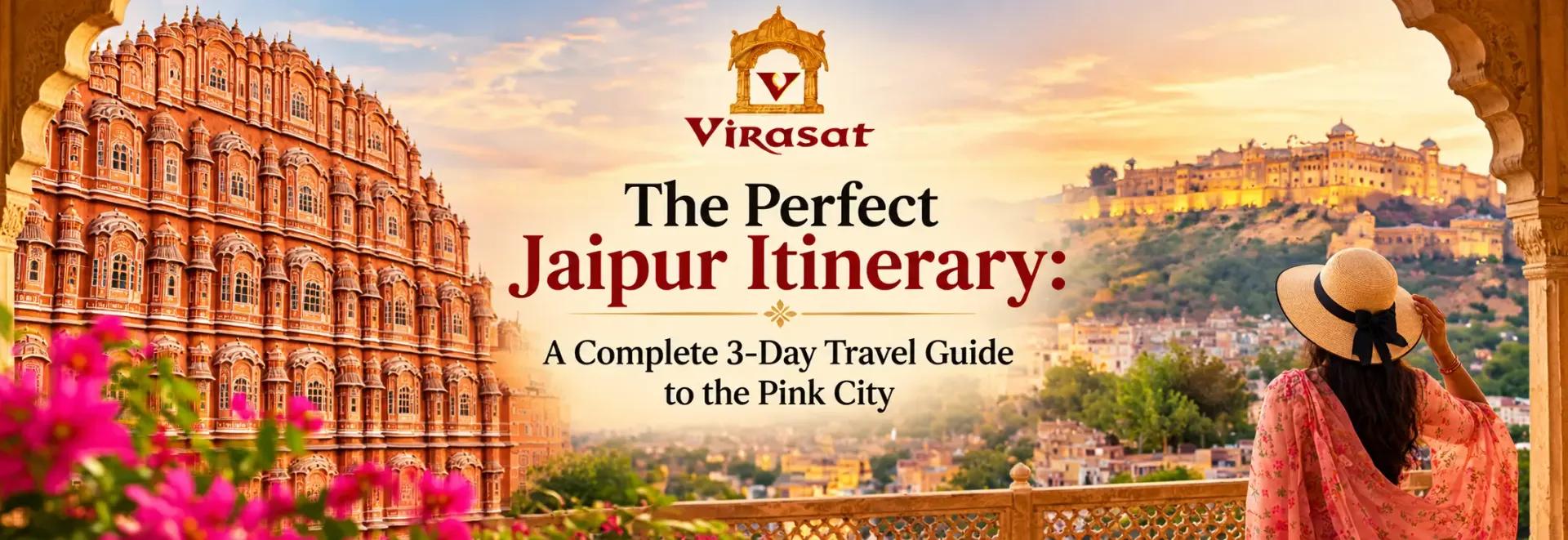
The Perfect Jaipur Itinerary: A Complete 3-Day Travel Guide to the Pink City
What Is the Best Jaipur Itinerary?
The ideal Jaipur
itinerary runs across 3 days: Day 1 inside the walled Pink City
for City Palace, Hawa Mahal, and Jantar Mantar; Day 2 on
the hilltop forts Amber Fort, Nahargarh Fort, and Jaigarh Fort
and Day 3 for Jal Mahal, local bazaars, and a royal dining experience
at a genuine heritage restaurant in
Jaipur such as Virasat Heritage Restaurant on the Jaipur–Delhi
Highway. This pacing leaves room to actually stand inside a 500-year-old
fort courtyard instead of just photographing it from a moving car, and to end
the trip with authentic Rajasthani cuisine rather than a rushed roadside
meal.
Why Jaipur Deserves More Than a Rushed One-Day Tour
Most
travellers arrive in Jaipur with a mental checklist: Amber Fort, Hawa
Mahal, maybe a bazaar and try to squeeze it all into a single, exhausting day.
The problem is that Jaipur was never built to be seen that way. It was
built by the Kachwaha rulers as a planned capital, laid out on
principles of Vastu Shastra, with wide avenues, pink sandstone facades,
and forts positioned on the surrounding hills specifically to watch over the
city below. Rush through it, and you'll collect photographs. Slow down even
slightly, and you start noticing the details that actually make Rajasthan's
royal history come alive: the hand-painted frescoes fading gently on a
haveli wall, the smell of ghee and cardamom drifting out of a sweet shop
in Johari Bazaar, the specific angle at which afternoon light hits Hawa
Mahal's 953 small windows and turns the whole facade the colour of a
sunset.
A well-paced
3-day Jaipur itinerary isn't about doing less; it's about doing the same
landmarks with enough breathing room to actually absorb them, followed by
evenings that feel like a genuine part of Rajasthan rather than a hotel buffet
afterthought. That's exactly what this guide is built around.
How Many Days Do You Actually Need in Jaipur?
If someone
tells you Jaipur can be "done" in a day, they mean the version
where you see everything through a car window. In reality, 2 to 3 days
is the realistic range, and the difference between them comes down to what
you're willing to skip.
A 2-day Jaipur itinerary forces some
hard choices you'll likely need to pick between Nahargarh Fort's sunset
views and a relaxed evening in the bazaars, and you'll probably eat quickly
rather than lingering over a proper Rajasthani thali. It works if you're
on a tight regional circuit that also includes Udaipur or Jodhpur.
A 3-day Jaipur itinerary, on the other
hand, gives each day a clear identity instead of cramming three forts and two
palaces into one exhausting loop. You get a full evening for Jaipur local markets,
enough daylight to properly explore Amber Fort's mirrored Sheesh Mahal
without being rushed out by a guide watching the clock, and importantly, a
slow, unhurried night reserved for a proper heritage dining experience
instead of whatever's closest to the hotel.
Best Time to Visit Jaipur And Why It Actually Matters
Here
The best
time to visit Jaipur is between October and March, and this isn't
just generic travel advice; it directly shapes how much of the itinerary below
you'll actually enjoy. Amber Fort and Nahargarh Fort involve genuine
uphill walking across open stone courtyards with almost no shade. In May and
June, Jaipur regularly crosses 44°C (111°F), which turns a leisurely
fort exploration into a race to find the nearest patch of shadow.
Winter
evenings, by contrast, are when the city genuinely comes alive. Temperatures
drop to a comfortable 12–20°C, which is exactly when outdoor heritage
dining and courtyard cultural performances feel their best; you can sit
outside through a full multi-course Rajasthani thali without breaking a
sweat, while live folk music carries clearly through the cool night air.
If your trip includes an evening at a heritage restaurant, winter is
genuinely when that experience is at its most magical.
Day 1: Losing Yourself in the Walled Pink City
Begin inside
the walled Pink City, the original planned capital built in 1727
and painted its signature terracotta-pink in 1876 to welcome the Prince
of Wales, a colour the city has proudly kept ever since.
Start at City
Palace, a sprawling complex where Rajasthani and Mughal architecture
meet in painted archways, marble-floored courtyards, and armouries displaying
weapons once carried by Jaipur's warrior-kings. Part of it is still the royal
family's private residence, which gives the visit an unusual sense that history
here isn't sealed behind glass; it's still, quietly, being lived.
A short walk
away sits Jantar Mantar, a UNESCO World Heritage astronomical
observatory built by Maharaja Jai Singh II in the early 18th century.
Its giant stone instruments, some over 27 metres tall, were engineered to track
the sun, moon, and stars with an accuracy that still startles modern
astronomers. It's one of those places where the scale alone makes you stop
talking for a moment.
End the
morning at Hawa Mahal, the Palace of Winds, famous for its
honeycomb facade of 953 small latticed windows, originally built so
royal women could observe street life below without being seen themselves.
Arrive in the early morning when the sandstone catches the low sun; it
photographs completely differently than it does at midday.
As evening
falls, wander into Johari Bazaar and Bapu Bazaar for local shopping,
block-printed textiles, traditional Rajasthani jewellery, and leather juttis
lining narrow lanes lit by string lights. This is also the right moment to try
your first Rajasthani Street food: a hot, flaky Pyaaz Kachori or
a fiery Mirchi Vada, eaten standing at a stall the way locals actually
do it a small, unglamorous ritual that somehow tells you more about Rajasthani
flavours than any restaurant menu can.
Day 2: Climbing Into Jaipur's Military and Royal Past
Day two
belongs entirely to the hilltop forts ringing the city structures built
not for beauty but for defense, which somehow makes them more beautiful for it.
Amber
Fort is the undisputed centrepiece: a honey-colored fortress-palace rising
out of the Aravalli hills, best reached in the early morning before tour buses
arrive. Inside, the Sheesh Mahal (Mirror Palace) is the moment everyone
talks about afterwards: thousands of tiny mirrored fragments set into the walls
and ceiling, designed so that a single candle flame, once lit, would be
reflected into what looked like a thousand stars. Guides here still demonstrate
the trick, and it works exactly as intended, centuries later.
From Amber,
it's a short drive up to Jaigarh Fort, built primarily to guard Amber
Fort itself and home to the Jaivana Cannon, the largest cannon on
wheels ever built, cast in Jaipur's own foundry and reportedly fired only
once, purely as a test. The fort also offers one of the clearest views over the
surrounding valley, a good place to genuinely understand why this hill was
chosen in the first place.
Save Nahargarh
Fort for last and time it deliberately for sunset. Built as an
additional line of defence for Jaipur and later expanded with royal apartments,
it now looks directly down over the entire Pink City as the light turns gold
and then rose. It's a genuinely different, quieter kind of view than anything
else on this itinerary worth the wait.
Because Amber,
Jaigarh, and Nahargarh sit close together on the same range of hills, all
three fit comfortably into one day, leaving the evening completely free, tired
legs, but nothing left to plan before dinner.
Day 3: Water Palaces, Museums, and a Royal Dinner to Remember
Your final
day should slow down even further: fewer monuments, more atmosphere.
Start at Jal
Mahal, the "Water Palace" that appears to float in the
middle of Man Sagar Lake, with four of its five floors submerged beneath
the water. You can't enter it, but the shoreline view, especially in early
morning mist, is one of Jaipur's most striking and far less crowded than the
forts.
Follow it
with Albert Hall Museum, Jaipur's oldest museum, housed in an ornate Indo-Saracenic
building that's arguably as impressive as anything inside it. The collection
ranges across Rajasthani miniature paintings, traditional textiles,
and even an Egyptian mummy an unexpectedly eclectic stop that rounds out the
historical picture beyond forts and palaces alone.
Spend the
late afternoon on a final, unhurried round of local markets, picking up block-printed
textiles or traditional Rajasthani jewellery without the time
pressure of Day 1.
Then close
the trip the way it deserves to be closed: with a royal dining experience
at Virasat Heritage Restaurant, located on the Jaipur–Delhi Highway
in Kukas. Guests are welcomed the way honoured visitors once were in
Rajasthani courts, with traditional teeka and aarti rituals at the door
before settling into a palace-style heritage ambience complete with live
folk music and carved, traditional décor. The meal itself is an authentic
Rajasthani thali: slow-cooked Dal Baati Churma, tangy Gatte ki
Sabzi, and desert-grown Ker Sangri, served in brass and clay
utensils the way they would have been centuries ago. After two days of
forts and history, this is the evening where all of it finally becomes
something you can taste: the perfect, deliberate ending to a Jaipur
itinerary that was never meant to be rushed.
Where to Eat Across Your Jaipur Trip: A Day-by-Day Food
Map
Food
deserves its own place in any Jaipur travel itinerary, not just an
afterthought squeezed between monuments. Here's how it should ideally flow
across your three days:
Mornings
are for street food a hot Pyaaz Kachori or crunchy Mirchi Vada
from a local stall, the same breakfast Jaipur residents have grown up on, best
eaten fresh and standing rather than boxed for later.
Middays,
between fort visits, call for something more substantial a Rajasthani Thali
near your sightseeing route, giving you a proper sample of dal, baati, gatte
ki sabzi, and rice without derailing the day's schedule.
Evenings,
especially your last night in the city, are where the trip should slow down
entirely. This is the moment for a proper heritage dining experience at Virasat
Heritage Restaurant not a quick bite, but a full royal hospitality
experience with ritual, ambience, and food designed to be lingered over rather
than rushed through.
Practical Tips That Actually Make a Difference
Getting
around: pre-book a cab or auto-rickshaw for the full day rather than
hailing one attraction to attraction Jaipur's forts and landmarks are spread
far enough apart that a day-rate driver saves both time and negotiation
fatigue.
What to
wear: light, breathable fabrics work best given the climate, but pair them
with genuinely comfortable walking shoes the stone courtyards and uphill paths
at Amber and Nahargarh are unforgiving on flip-flops, however tempting
they seem in the heat.
Water and
shade: carry more water than you think you'll need. Fort courtyards offer
almost no shade at midday, and dehydration sneaks up faster in Rajasthan's dry
heat than most travellers expect.
Booking
heritage dining ahead: if you're travelling with a large group or tour
bus, call ahead. Venues like Virasat Heritage Restaurant prepare
seating, welcome rituals, and kitchen timing in advance for bigger parties, and
a heads-up ensures the experience isn't rushed on their end either.
Respecting
local customs: cover shoulders and knees at temples, and always ask before
photographing residents, particularly in the older lanes of the Pink
City.
Sample 3-Day Jaipur Itinerary at a Glance
●
Day 1: City Palace, Jantar Mantar, Hawa Mahal,
evening bazaar walk and street food in Johari Bazaar
●
Day 2: Amber Fort (morning), Jaigarh Fort
(midday), Nahargarh Fort (sunset)
●
Day 3: Jal Mahal, Albert Hall Museum, final
market round, royal dinner at Virasat Heritage Restaurant
Final Thoughts
A good Jaipur
itinerary isn't measured by how many forts you can tick off a list; it's
measured by how many moments actually stay with you afterwards. The candlelight
trick inside Amber Fort's mirrored hall. The particular gold of Nahargarh
Fort at sunset. And, if you plan it right, a final evening where teeka,
aarti, live folk music, and a proper Rajasthani thali at Virasat
Heritage Restaurant turn a trip about Rajasthan's history into one you
actually got to taste, hear, and feel, not just photograph.
Frequently Asked Questions
How many days are ideal for a Jaipur itinerary?
Most
travellers need 2 to 3 days. A 3-day Jaipur itinerary is ideal
because it allows unhurried time at major forts, local markets, and a proper heritage
dining experience without feeling rushed.
What are the must-visit places in a Jaipur itinerary?
Essential
stops include Amber Fort, City Palace, Hawa Mahal, Jantar
Mantar, Nahargarh Fort, and Jal Mahal, paired with a royal
dining experience to complete the trip.
What is the best time of year to visit Jaipur?
The best
time to visit Jaipur is October to March, when cooler temperatures
make fort and palace sightseeing far more comfortable, and evenings are
ideal for outdoor heritage dining.
Where should I go for an authentic Rajasthani dining
experience in Jaipur?
Virasat
Heritage Restaurant, on the Jaipur–Delhi Highway in Kukas, offers a ceremonial
royal welcome, palace-style ambience, and an authentic Rajasthani
thali, a popular choice to close out a Jaipur itinerary.
Can Amber Fort, Jaigarh Fort, and Nahargarh Fort be
covered in one day?
Yes. Since Amber
Fort, Jaigarh Fort, and Nahargarh Fort sit close together on
the same hill range, they comfortably fit into a single day of Jaipur
sightseeing, typically finishing at Nahargarh for sunset.
Is Jaipur suitable for a family trip?
Yes. Jaipur
combines family-friendly attractions with spacious heritage
restaurants and manageable travel logistics, making it well suited for family
travel.
Should I book a heritage restaurant in advance while
planning my Jaipur trip?
Yes, especially for large groups or tour buses. Restaurants such as Virasat Heritage Restaurant prepare seating and welcome rituals in advance for bigger parties, ensuring a smooth group dining experience.